I just finished watching the Movie-Conclave the other day. I enjoyed it very much. However, my enjoyment would have been doubled if I had not read the original novel and reviews of the movie that I posted in my blog as a SPOILER ALERT. It is worthy to note that Robert Harris' original book of the same name, on which director Edward Berger's terrific Conclave is based, Vincent Benitez is a Filipino assigned as the Archbishop of Baghdad. It's a very important character that's key to a major twist in the film. There was no reason why the actor in the Film was a Mexican and not a Filipino. I know there a few Filipino movie actors that could have been hired for the movie. I would appreciate if the Conclave Movie Producer has an explanation to this discrepancy.
Here's a summary of the novel from Wikipedia- Conclave for your reading pleasure. Conclave 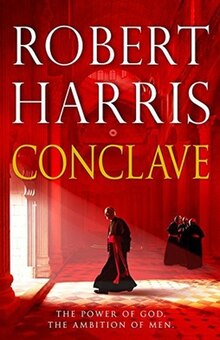 |
| Author | Robert Harris |
|---|
| Language | English |
|---|
Publication date | 2016 |
|---|
| Publication place | United Kingdom |
|---|
Conclave is a 2016 novel by British writer Robert Harris. The book is set in the context of the death of a pope and the subsequent papal conclave to elect his successor.
A film based on the book, starring Ralph Fiennes, directed by Edward Berger and written by Peter Straughan, was theatrically released in the United States by Focus Features on 25 October 2024.
Plot
Jacopo Lomeli is summoned to the Casa Santa Marta, where the pope has died in his sleep of a heart attack. The death is not suspicious, as the late pope had a history of heart problems, and a review of his schedule the preceding day indicates nothing out of the ordinary, only a meeting with Camerlengo Joseph Tremblay followed by dinner with Archbishop Janusz Woźniak, the Prefect of the Papal Household. As the Dean of the College of Cardinals, the responsibility for overseeing the next papal conclave falls to Lomeli.
Following the pope's funeral, four cardinals emerge as the leading candidates to become the new pope: Aldo Bellini of Italy, the late pope's Secretary of State and the candidate supported by the Church's liberal wing; Joseph Tremblay of Canada, Camerlengo and Archbishop Emeritus of Quebec; Joshua Adeyemi of Nigeria, the Cardinal Major Penitentiary; and Goffredo Tedesco of Italy, the reactionary Patriarch of Venice. Shortly before the 118 cardinals are sequestered for the duration of the conclave, Woźniak approaches Lomeli and claims that the late pope had divulged to him during their final dinner that he had demanded Tremblay's resignation.
The late pope had not explained why this was necessary and stated only that the reason would soon be made apparent. Lomeli is taken aback by this news, as there was no record of Tremblay being dismissed. The dean sends Monsignor Raymond O'Malley, his assistant, to Monsignor Morales, the late pope's private secretary and an alleged witness to Tremblay's dismissal, to get corroboration for Woźniak's story. Morales denies the incident occurred, but inadvertently reveals the existence of a "withdrawn report" tied to Tremblay.
During the Mass preceding the conclave's first ballot, Lomeli is inspired to give an off-the-cuff homily. Although he expected it to be controversial, he is frustrated when some of the cardinals misinterpret the homily as making a play for the papacy. In the first ballot, no one garners the two-thirds majority (79 of 118 votes) necessary to win the election; Tedesco secures 22 votes, Adeyemi 19, Bellini 18 and Tremblay 16, solidifying them as the main contenders.
Vincent Benítez, a Filipino and the Archbishop of Baghdad whom the late pope had created cardinal in pectore, remarkably receives one vote despite not being known to the other cardinals until his unannounced arrival in Rome for the conclave. Lomeli, a supporter of Bellini, is dismayed to receive five votes and blames himself for Bellini making a weaker-than-predicted showing. That night, Lomeli is shocked to see an unchaperoned nun leaving Adeyemi's room, but hesitates to press Adeyemi about it.
Over the next two ballots, Adeyemi builds momentum and takes a commanding lead of 57 votes, while Bellini's prospects evaporate. At lunch, however, there is a commotion involving Adeyemi and a Nigerian nun, Sister Shanumi Iwaro. Lomeli asks for the sister's confession, and learns that thirty years previously, when she was a young postulant and Adeyemi was a village priest, the two had an illicit relationship that produced a child who was given up for adoption.
The lunch incident had resulted from Shanumi becoming upset by Adeyemi's refusal to acknowledge her. Lomeli is bound not to divulge details of the confession, but the lunch incident ignites speculation of a possible scandal and the dean lets it be known to Adeyemi's supporters that what he did was significant enough that he will have to resign his offices after the conclave. This effectively dooms Adeyemi's candidacy, and support for him plunges in the fourth and fifth ballots.
The main contenders are reduced to two by the fifth ballot: Tremblay with 40 votes and Tedesco with 38. Bellini reluctantly decides to support Tremblay to keep Tedesco from becoming pope. Lomeli investigates Sister Shanumi's sudden transfer to Rome from Nigeria, which occurred just before the pope's death, and discovers the transfer request originated from Tremblay. He accuses Tremblay of scheming to blackmail Adeyemi and demands he withdraw his candidacy, but Tremblay refuses and unconvincingly claims that he made the request on the late pope's behalf.
After nightfall, Lomeli breaks the seals on the late pope's quarters in search of any evidence for his accusation. He instead finds four hidden compartments in the bed frame containing the financial records of the entire Curia, as well as the "withdrawn" Tremblay report: an analysis of Tremblay's activities as Prefect of the Congregation for the Evangelization of Peoples that indicates he committed simony by giving cash payments to several cardinals over the past year.
At breakfast on the third day of the conclave, Lomeli distributes copies of the Tremblay report, with the bribe recipients' names redacted, to the other cardinals. This, coupled with the revelation that Tremblay requested Sister Shanumi's transfer, kills his candidacy and upends the conclave again. In the sixth ballot, Tedesco leads with 45 votes, with Lomeli a close second and Benítez a distant third. As voting on the seventh ballot commences, an explosion rocks the Sistine Chapel, but since no one is injured and only windows are shattered, the process continues. Lomeli is catapulted to front-runner status with 52 votes, and trailed by Tedesco and Benítez.
The cardinals break for lunch, and the dean is informed that the explosion was part of a series of coordinated terrorist attacks against Catholic institutions across Europe that were carried out by Muslim extremists. In light of this grim news and dueling speeches by Tedesco and Benítez, the former exhorting retaliation and the latter arguing against meeting violence with violence, the cardinals agree to skip their meal and proceed immediately to the eighth ballot.
The eighth ballot sees Benítez elected pope with 92 votes, fulfilling the two-thirds majority requirement. Benítez consents to the honor and chooses the name Innocent XIV. Just before the result of the conclave is publicly revealed, however, O'Malley brings to Lomeli's attention that Benítez had booked and later abandoned an appointment at a gender reassignment clinic in Geneva earlier that year.
Lomeli privately asks Benítez for an explanation. The new pope reveals that he was born intersex and raised as a male by his parents. For most of his life, he was entirely unaware that his physical characteristics were different in any way from other males. It was only after he was injured in a bombing in Iraq that he was examined by a doctor for the first time in his life and informed of his condition.
Benítez had tried to resign from his office to undergo gender reassignment surgery, but the late pope refused his resignation and created him cardinal in pectore with full knowledge of his condition. Benítez ultimately declined surgery and resumed his duties. Lomeli knows that Benítez's condition will inevitably be discovered by a future medical examination or upon his death, but resolves to keep it secret for now, trusting that God's will guided the conclave's outcome.
Characters
- Cardinal Jacopo Baldassare Lomeli—Dean of the College of Cardinals, and Cardinal-Bishop of Ostia. The responsibility of overseeing the papal conclave falls to Lomeli. In recent months, Lomeli has been experiencing a crisis of faith, and his desire to resign created a rift with the late pope, who insisted he stay on. He considers himself unworthy of his role as dean and supports his friend Bellini, but is intent on leading the conclave as neutrally as possible.
- The late pope—The unnamed pope whose death prompts the papal conclave. The late pope is described as a reformist who eschewed much of the ostentation and pageantry of his office. His reforms and liberal stances made him popular among the public, but provoked resentment from many within the upper echelons of the Holy See. Over the course of his final months, he became avidly focused on rooting out corruption in the Church.
- Cardinal Aldo Bellini—Secretary of State, and former Archbishop of Milan. Viewed as an intellectual and the ideological successor of the late pope. He is the candidate of choice of the liberal wing of the Church, and the initial favorite to win the election.
- Cardinal Joseph Tremblay—Camerlengo, Prefect of the Congregation for the Evangelization of Peoples, and Archbishop Emeritus of Quebec. An ambitious, news media-savvy candidate with vaguely liberal leanings. He is influential among the cardinals from developing countries and North America.
- Cardinal Joshua Adeyemi—Cardinal Major Penitentiary, and former Archbishop of Lagos. A traditionalist candidate backed by the other African cardinals, he is charismatic and discussed in the press as having a viable path to becoming the first African pope despite his militant opposition to homosexuality.
- Cardinal Goffredo Tedesco—Patriarch of Venice. A staunch traditionalist and the late pope's most prominent critic. Politically cunning and supported by the Church's conservative wing, he is considered a long-shot candidate whose primary goal is to amass at least 40 votes in order to block any liberal candidates from achieving the necessary two-thirds majority.
- Cardinal Vincent Benítez—Archbishop of Baghdad. A Filipino. His arrival to the conclave comes as a surprise, as he was created cardinal in pectore by the late pope in the months before his death. He has a storied reputation for establishing shelters for abused women and children in the Philippines and the Democratic Republic of the Congo before the late pope appointed him to the vacant archdiocese in Iraq.
- Archbishop Janusz Woźniak—Prefect of the Papal Household. A Pole. Known as a close friend of the late pope. Shortly before the conclave begins, he makes a startling claim to Lomeli about Tremblay.
- Archbishop Wilhelm Mandorff—Master of Papal Liturgical Celebrations. A German. One of Lomeli's assistants.
- Monsignor Raymond O'Malley—Secretary of the College of Cardinals. An Irishman. One of Lomeli's assistants.
- Sister Agnes—A French nun of the Daughters of Charity of Saint Vincent de Paul. She is in charge of running the Casa Santa Marta during the conclave.
- Sister Shanumi Iwaro—A Nigerian nun of the Daughters of Charity. Shortly before the death of the pope, she was abruptly transferred from Nigeria to Rome, despite never seeking a transfer and not knowing Italian.
Lastly, currently the Philippines has produced ten cardinals. On October 6, 2024, Pope Francis named Pablo Virgilio David, Bishop of Kalookan, as the tenth Filipino Cardinal. He was elevated to the College of Cardinals in a consistory on December 8, 2024.
The population of Catholics in the Philippines constitutes the country's largest religious denomination, as well as one of the largest Catholic populations among countries of the world. The Catholic faith was introduced to the Philippines by Spanish colonists in the sixteenth century. Some 400 years later, in 1960, Rufino J. Santos, the Archbishop of Manila, became the first Filipino cardinal. Since then, a total of ten Filipinos have been raised to the rank of cardinal. On May 1, 2020, Luis Antonio G. Tagle, Pro-Prefect for the Section of First Evangelization of the Dicastery for Evangelization, was promoted to the rank of cardinal-bishop. He is the first Filipino to hold the highest rank of a cardinal in the Catholic Church.
Currently there are three active Filipino cardinals, Luis Antonio Tagle, current Pro-Prefect of the Dicastery for Evangelization, Jose Advincula, current Archbishop of Manila, and Pablo Virgilio David, current Bishop of Kalookan.
 A spellbinding novel of passion, intrigue, and betrayal set in England in the months leading to the Great War from the bestselling author of Act of Oblivion, Fatherland, The Ghostwriter, and Munich.


 “Robert Harris is, simply put, masterful.”—Karin Slaughter


